When small teams look for an open-source replacement for Intercom or Zendesk, Chatwoot and Zammad almost always top the shortlist. Both say “free to self-host” on the tin—until you check the license fine print for agent roles or size the production VM.
Here is the exact cost, license, and hardware trade-off between the two based on their November 2026 documentation.
1. The Chatwoot -ce split: MIT core vs $19–$99/agent open-core gates
Chatwoot’s core (-ce Docker image tag) is MIT-licensed and genuinely $0 in software fees for unlimited agents on a modest Linux VM (minimum 2 vCPUs / 4 GB RAM; 4+ vCPUs / 8+ GB RAM recommended for production with PostgreSQL 12+ and Redis 6+).
The catch sits inside the enterprise/ directory of the repository, which uses a proprietary Enterprise license:
- Custom roles & permissions, custom branding, agent capacity, and Captain AI are excluded from the Community edition. Unlocking them on your own server requires Self-Hosted Premium Support at $19/agent/month (billed annually).
- SSO / SAML and SLA policies require Enterprise at $99/agent/month.
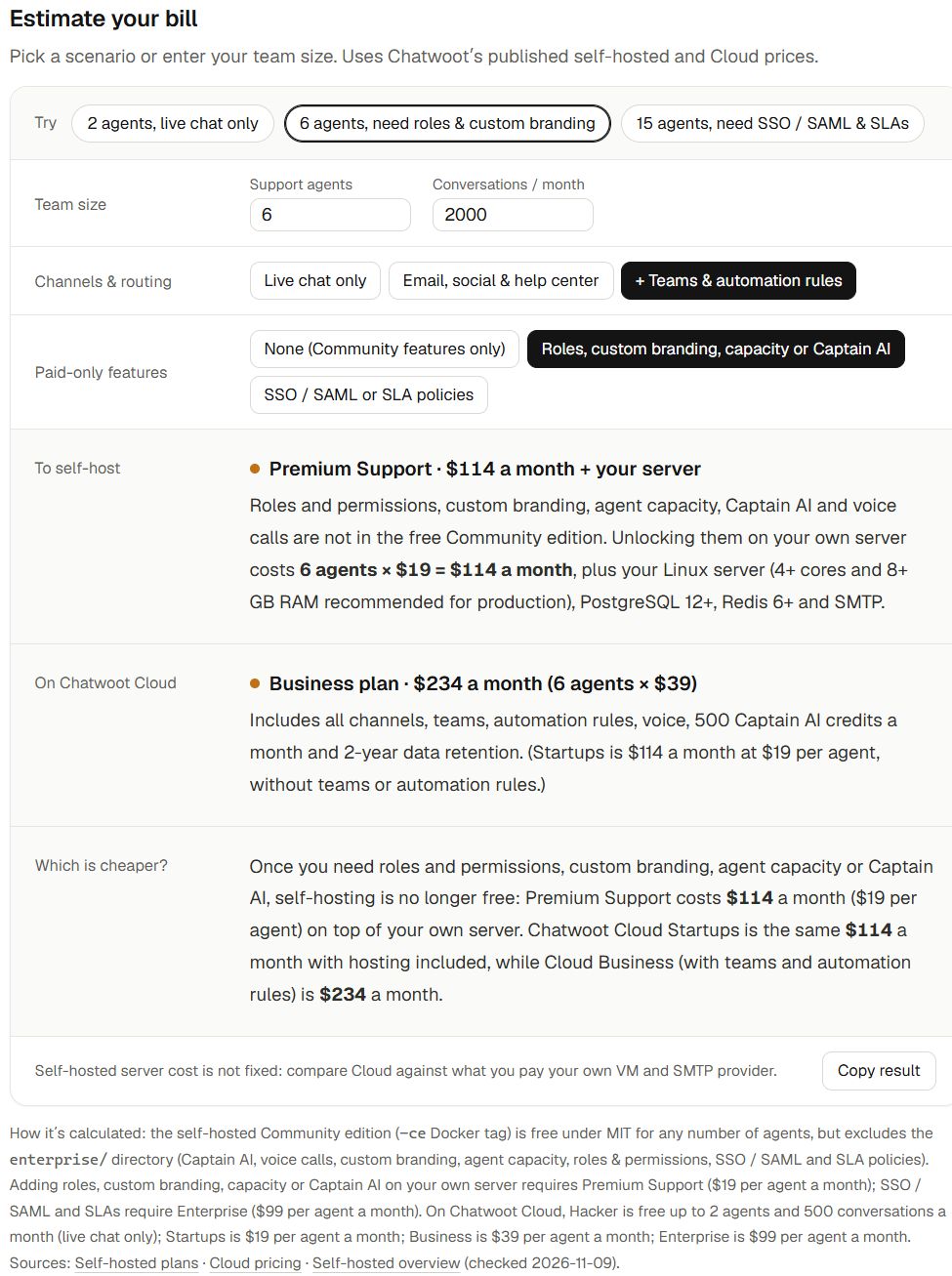
For a 6-agent team needing roles and custom branding, self-hosting Chatwoot is no longer $0—it costs $114/month ($19 × 6) plus your Linux VM and SMTP provider, compared to $234/month on Chatwoot Cloud Business (if you also need teams and automation rules). You can plug in your exact agent count and feature flags on the interactive Chatwoot self-hosted vs Cloud cost calculator.
2. Zammad’s trade-off: $0 seat gates under AGPL-3.0, but budget 10–12 GB RAM
Unlike open-core tools, Zammad (stewarded by the independent Zammad Foundation) releases its full feature set—including granular roles, SLAs, ticket macros, and SSO—under GNU AGPL-3.0 with zero per-seat feature paywalls when run unmodified.
Instead of license fees, you pay in server memory:
- Elasticsearch is effectively mandatory: Zammad boots without it, but reporting and attachment full-text search depend on Elasticsearch (and Docker hosts must raise
vm.max_map_countto262144). - RAM baseline: Official docs specify 2 cores + 6 GB RAM for Zammad plus 4 GB RAM if Elasticsearch runs on the same machine (~10 GB RAM minimum, or 6 cores + 12 GB RAM for up to 40 agents).
3-Step Rule of Thumb
- Live chat widget first, no custom roles needed → Run Chatwoot
-ce(MIT) on an 8 GB VM for $0 software cost. - Email/ticket workflows + roles, SLAs, or SSO for 6+ agents → Run Zammad on a 10–12 GB VM to avoid $114–$1,485/month in open-core seat fees.
- Comparing more self-hosted apps? Check primary-source license rules and server sizing across 22 business tools at BuilderStack.
About the author
- Documenting primary-source license fine print, server sizing, and real self-hosting vs SaaS seat costs for open-source business apps at https://dceniac.com.
Comments
Join the discussionNo comments yet. Be the first to comment.